- Published by
- Helena Duppre
- Date
- Category
- reflections
- Reading time
- 5 min
From /imagine to a team of agents
keywords: applied ai, product design, process, career
From Midjourney to Claude: my journey with AI applied to product design, from asking a Discord bot for images to directing teams of agents today.
The AI and I have been working together for a while now. I figured it was time to tell how this duo came to be, from my early struggles on Discord to it becoming part of the way I think about work.
My first time was late one night, inside a Discord server, typing /imagine to a bot and hoping something would come out resembling what I had in my head. It almost never did. I'd tweak the sentence, send it again, tweak it once more. In the middle of all that, I had no idea I was training the most important skill of all: how to ask.
This was back around 2022, when Midjourney still lived inside Discord and looked more like a nerdy pastime than a work tool. Yeah. Since then I've switched tools a bunch of times, and the way I work kept changing right along with them.
Long before any AI, code was already with me
Except, if I'm honest, that isn't even the first scene. Design and code had been with me long before any AI. Around age 9 or 10 I was building crooked little databases in Access and, in fourth grade, when the first Harry Potter came out, laying out a little newspaper about it in Word. Can you believe it? Both halves of what I still do today, the layout and the logic, were already there. Then came years shoulder to shoulder with developers and building design systems, exactly where design and code actually touch. When AI finally arrived, it didn't find a blank page: it found years of accumulation and gave it an outlet.
And there's something I only realized now, laying out this timeline: I was circling the idea of AI long before I could actually use one. Back in 2018, on Gina, the project that changed my life, I designed a health assistant I called a chatbot at the time. It did triage, helped book appointments, and flagged possible diagnoses, inspired by Watson, IBM's AI. I had no way to build that on my own yet, and the tool for it was still years away. But the mindset was already there.
The best example of that is generative art. The kind made with code I'd tried well before. Years earlier I'd studied Processing with Python precisely to make it by hand, and I got stuck. I had the basic notion, I could read the code, I understood the logic behind it, but I couldn't reach the result I was imagining on my own. It was with ChatGPT that it finally clicked. I'd describe the idea, it would write the Processing, I'd read it, adjust, figure out where I'd gone wrong, and ask again. For the first time, the generative art living in my head made it onto the screen.
Today I read CSS, HTML, Python, and a bit of JavaScript. Some of that came from before, from design systems and from being around people who code; some was refined in this back-and-forth with the machine. Not to become a developer, but to talk on equal footing: to ask precisely, to understand what it hands me, and to catch it right away when something doesn't add up.
Today I spend most of my time with Claude, across every version that's come out, alongside a whole set of other tools for each kind of task. And it's no longer "make me an image" or "write me a text". We build things together: apps, websites, workflows, and even teams of agents, each with a role, talking to one another to handle a whole project.
What really changed wasn't the tool
And here comes the part I most like to sit with. What actually changed over these years? The tool changes every week, everyone can see that. Fact. But if it were only that, I'd just be a person who swaps apps now and then. What changed was me.
On Discord I was a user. I took whatever the bot handed me and accepted it. Today I direct. I know what I want before I ask, I know how to break a big problem into pieces, I know when a result is genuinely good and when it's just pretty. The skill I've been building has less to do with "knowing how to use AI" and more with knowing how to think out loud with it and lead.
There's a line that stuck with me: code became the designer's material. I agree, and I'd push it further. For me the whole of AI became working material, not just the code. It stopped being that trick you pull out now and then and became part of how I think about the problem from the very first line. When that turns into a mindset, and no longer a stray tool, the work moves up a level: what took weeks starts coming out in a single cycle, and it frees up time for what only people do, which is deciding what deserves to exist.
And that, deep down, is design. When I assemble a team of agents, I'm doing the same thing I do in a product project: defining roles, drawing the flow between them, deciding what each one solves and how one hands off to the next. What gives AI its shape is still repertoire, judgment, and intent. No prompt generates that for you.
I won't romanticize it, because it isn't always pretty. Some days the tool leads me two hours down the wrong path. There are confident, completely wrong answers. There are moments I'd have been faster by hand. The difference is that now I notice when that's happening and I know when to pull the brake. That's the whole trick, and it's what separates someone who uses AI from someone who works with AI.
A tip for anyone just starting out
If you're just starting out and feeling behind, here's a tip I wish I'd heard earlier: don't try to "learn the tool". It's going to change anyway, that's its nature. Learn to ask. Take a small, boring task, write what you want as if you were explaining it to a sharp intern, look at the result with a critical eye, adjust, repeat. That's it. The rest is evolving as you go and playing with lego, the way it always was.
Writing all this down, a small and rather sweet realization hit me: the girl laying out a little newspaper in Word and tinkering with Access didn't take any shortcut to get here. She walked the whole way. And looking back, I'm exactly where I should be.
In the end, AI didn't take my place. It stretched the reach of what I already knew how to do. And I'm pretty curious to find out who I'll be working with the next tool, the one that doesn't even exist yet.
A kiss, and see you next time!
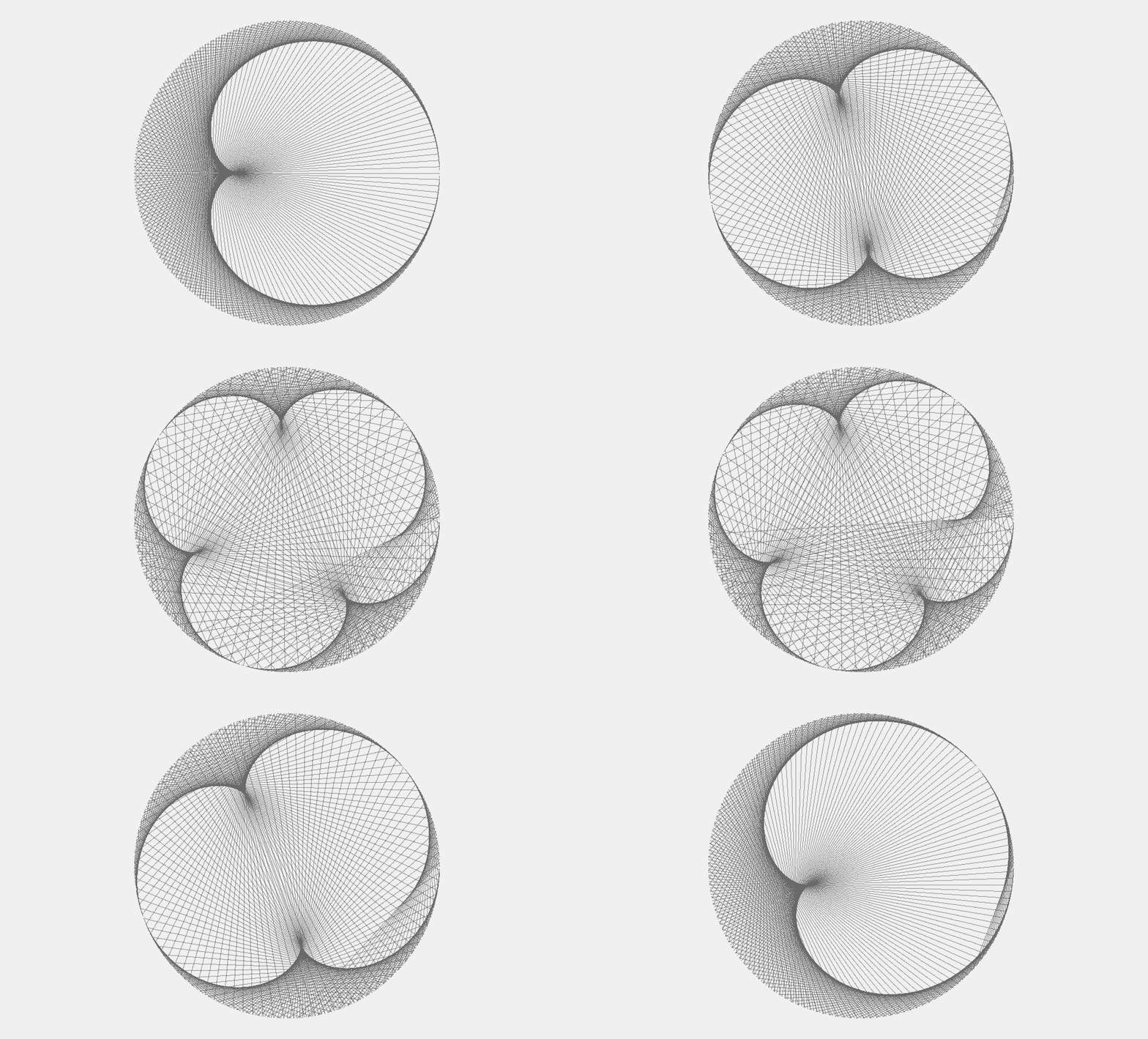
The cover of this post is a piece of generative art we made in code: a modular-multiplication string art, cousin to the piece I made for the Sebrae project, its base generated with GPT and refined and exported in Processing.
Read next
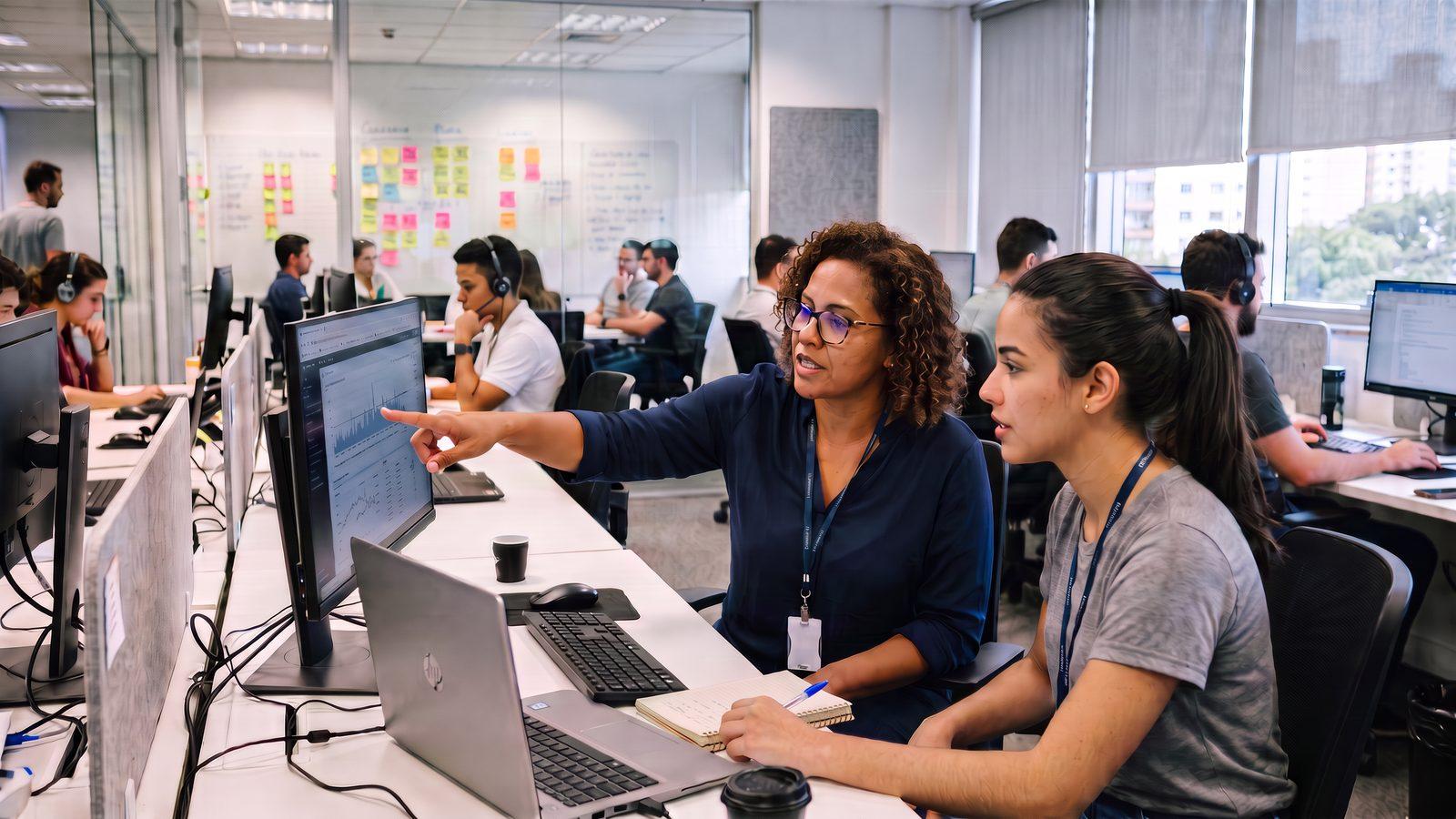
Leading people in the age of agents: what AI speeds up and what it hides
If one person with AI delivers what two used to deliver, has half the team become a cost? In the very experiment that arms that math, top-decile solutions were almost three times more likely to come from a pair with AI than from someone working alone without it. The math buys the average and sells the top — and it still leaves out the step where juniors used to learn.
12 min read
What is design? I came back to rewrite my own answer
I came back to rewrite my 2019 text. What changed? Empathy got more urgent in the age of AI, and data more important than ever.
3 min read
Your site's first reader isn't a person
In a Pew study of 900 people, when Google showed an AI summary, clicks on a search result fell from 15% to 8%. Clicking a link inside the summary happened on 1% of visits. Whoever reads your site first is now a machine, it doesn't run your JavaScript, and what it understands is a design decision.
9 min read
loading comments...